E.U. Privacy Organizations Launch Initiative to Kill Cookie Consent Banners ⇥ cybernews.com
In September, the European Commission began pondering how to correct its 2009 privacy law that resulted in cookie permission banners littering the web, with the resulting proposal announced in November.
Jennifer Rankin, the Guardian:
EU officials said users would remain in control of their data on the internet, but new rules on cookies — the internet files that are stored on a user’s device so a website can remember them — would make life simpler by ensuring one-click consent. “I think we can all agree we have spent too much of our time accepting or rejecting cookies,” [Henna] Virkkunen said.
This was not the first time the Commission had attempted to correct for the permissions pollution that resulted from the e-Privacy Directive. In 2020, its efforts were focused on ineffective consent options like, as reported at the Verge, “a cookie consent policy with no obvious way to opt out of tracking”. I still see many websites, like the Verge itself, providing no meaningful consent for third-party tracking.
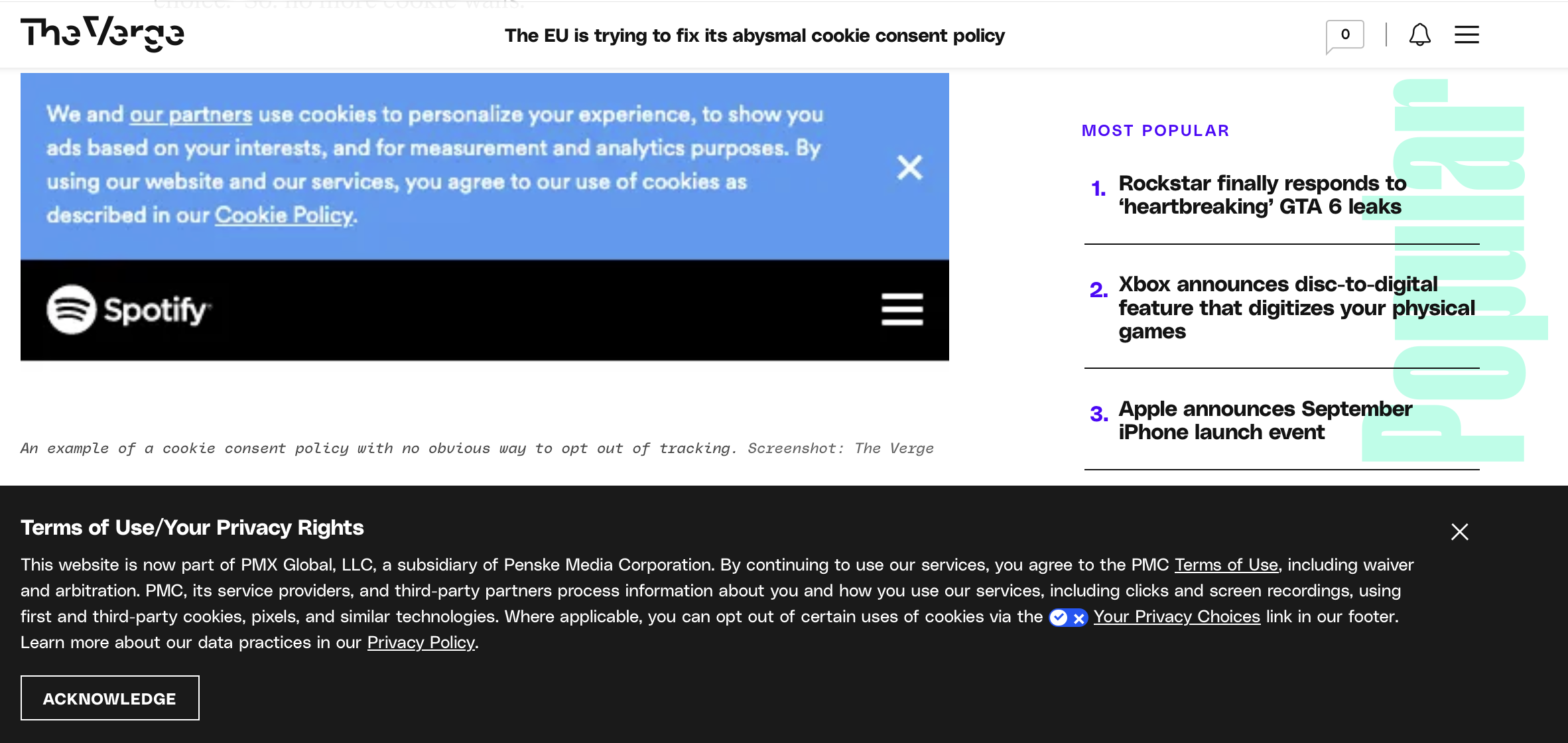
This time, though, the Commission said it was trying to make cookie consents less prevalent by allowing, for example, simple statistical cookies without any consent, and it was going to give users an option to decline tracking universally. When I looked into the changes in November, it seemed like this signal could be ignored by publishers and media companies who would be free to ask for consent anyway. As of May, it seemed this proposal was moving forward by requiring consent management platforms to respond to browser signals. By summer, however, things had changed.
Ernestas Naprys, Cybernews (“Article 88b” refers to the universal browser signal proposal):
Google suggested ditching Article 88b.
“Article 88b should be deleted. Retaining this provision risks anchoring the Omnibus to a proven-failed architecture, Google’s position reads.
“It will drastically impair the ability of most websites to monetize content and drive client acquisition. The resulting low consent rates and severely restricted data access.”
Meta suggested removing the entire Article 5(3) of the ePrivacy Directive. This rule is why we have cookie banners in the first place, as it requires website operators to obtain clear user consent before storing or accessing their information.
It was not just U.S.-based companies that argued against better user privacy controls. According to noyb, French, German, and Polish representatives were in alignment with Google’s position, which ultimately led to its scrapping. All three countries are home to companies that would be affected by this regulation. None, however, are as big or as powerful as Google or Meta.
Privacy-defending organizations are understandably not impressed. They have launched Kill the Cookie Banner to drum up support for legal recognition of a browser signal. In the U.S., five state governments say the Global Privacy Control must be respected. At a browser level, it is only implemented in Brave, DuckDuckGo, and Firefox, but it seems that Apple is working to add it to Safari, and it seems it is being actively worked on for Chromium, too. The European Commission should throw its weight behind this control, too.